
Your Temperature Measurement Experts
SWE Time Response Comparison – 0.236” vs. 0.25” Sheath – Part 2
Date: 8/8/18
Test Report Number: 18006
Author: Josh Zahorik
Report Subject: SWE Time Response Comparison – 0.236” vs. 0.25” Sheath – Round 2
Introduction:
The purpose of this testing is to expand on the testing done in TR18002, which was a preliminary investigation into the performance of 6 mm and ¼ inch sensors when used with an SWE thermowell. This testing will investigate some of the limitations of the previous testing:
- Multiple sensors of each type will be tested
- Commercially available 6 mm sensors will also be tested, in addition to
- Various sensor build types will be tested
Test Units:
- 1 SWE thermowell, ¾ inch elbow size and 6 inch immersion depth
- 1 SWE thermowell, ¾ inch elbow size, 4.5 inch immersion depth and nipple/coupling
- 1 Burns Series 300 style 6 mm sensor
- 3 Burns Series 300 thin film ¼ inch sensors
- 3 Burns Series 200 ¼ inch sensors
- 3 commercially available thin film element 6 mm sensors
- 3 commercially available coil element 6 mm sensors
Results:
An attempt was made to test the accuracy using a thermowell immersed in an ice bath per the previous test report. However the ice bath melting rate became a larger source of error due to the time required to test the larger quantity of sensors, and attempts made to insulate the top of the bath resulted in eliminating the sensor error.
Because of this, accuracy within the thermowell was tested taking at a reading at 0°C for all sensors and an industrial sensor. Each sensor was then assembled to a 4.5” bore depth SWE thermowell and the standard was directly immersed into the process line. Ice water was pumped through the process line at tely 15 fps until full response was achieved.

The only sensor type that showed significant error in this testing were the ¼ thin film sensors, and increasing the bore depth from 4.5” to 6.0” did not have a substantial impact on this error. The initial guess was that this error was due to stem conduction, so the test was repeated with an ice pack placed around the lead wires. This significantly reduced the error, and it’s likely that if a perfect insulation method could be achieved that the error would be completely eliminated. As end users will not typically be insulating this portion of the sensor, further testing was not explored.
After the accuracy result was recorded, time response was tested by changing the pump from ice water to room temperature water and monitoring the time response. The 63.2% response times measured in the thermowell and the direct immersion response time measured per ASTM E644 are given below. Some tests were repeated to validate the testing process, and the measurements made in the thermowell had a margin of error of up to approximately 5%.
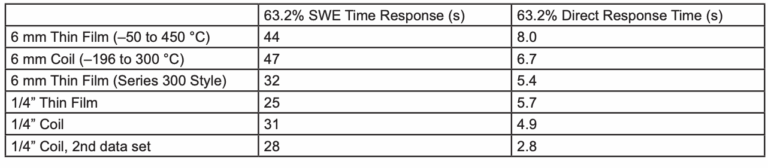
The time response in the SWE thermowell was up to 60% slower for the 6 mm sensors than the corresponding 1/4” sensor.
For a given sheath diameter, the coil element sensors performed faster than films when directly immersed, but slower when used within the thermowell. This could potentially be due to the shorter thin film element being further away from the mass of the thermowell. This will potentially be investigate further outside of the scope of this testing.
The SWE time response for the ¼” thin film design was also validated by first pumping room temperature water through the process line, then switching to ice water and measuring the time response. Results were within the margin of error for the test when compared to the ice water to room temperature time response, so the stem conduction issue did not significantly impact the time response.
A second set of Series 200 sensors were tested, as the direct time response observed was outside of the specification of the part. The second set tested within specification for direct response (75% improvement) and slightly faster within the thermowell (10% improvement). The initial set of sensors will be investigated to attempt to determine the cause of the time response issue, which has not been observed in the periodic product testing.
Conclusion:
If given enough time to respond, all sensors except the 1/4” thin film design were accurate when used in the thermowell. The ¼” thin film design showed signs of a stem conduction issue, which could be resolved by insulating the sensor lead wires.
If a process is not at or near steady state, 1/4” sensors should be used for SWE thermowell applications, as the time response improvement of up to 60% will provide a more consistent, reliable and accurate temperature measurement.